The Rise of Hybrid Energy Infrastructure: Grid, Solar and Batteries
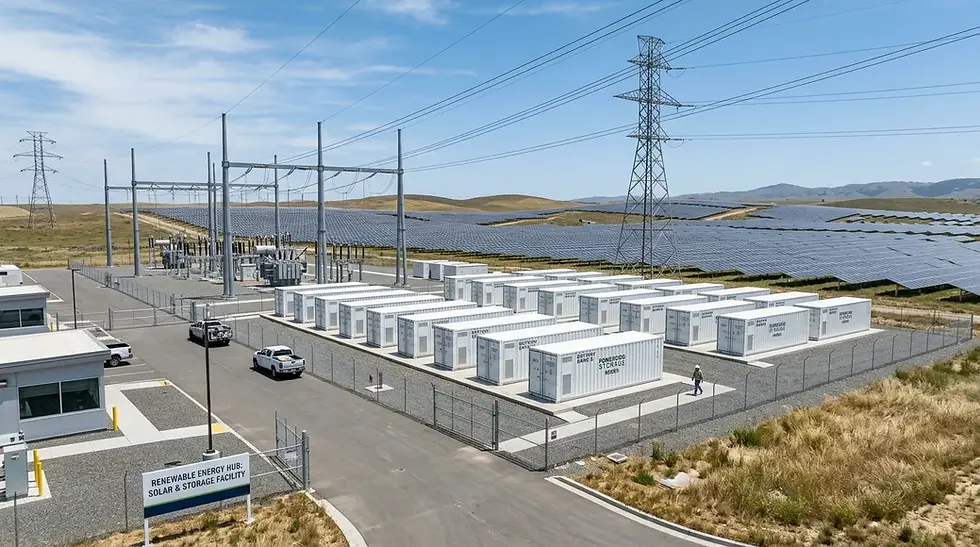
Hybrid energy infrastructure is no longer theoretical. It is becoming the practical answer to grids that must absorb more solar power, support fluctuating demand, and keep critical facilities running during disruptions.
The model links the grid, on-site solar, and batteries so electricity can be produced locally, stored, and dispatched when the system needs it most. That combination gives operators more flexibility than a single-source setup.
Why the Shift Is Accelerating
According to the IEA’s Electricity 2025 analysis, solar PV additions in 2024 rose to about 550 GW, installed capacity reached roughly 2.2 TW, and solar PV and wind together accounted for 95% of renewable capacity growth. IRENA’s solar overview says global solar PV capacity reached 1,865 GW by the end of 2024, with more than 451 GW added in that year alone.
That scale makes flexibility the real bottleneck. In Batteries and Secure Energy Transitions, the IEA says battery storage was the fastest-growing commercially available power technology in 2023, with 42 GW added globally. The IEA’s Electricity 2026 flexibility analysis then reports 108 GW of new battery storage deployed worldwide in 2025, showing how quickly storage is moving into the core of the system.
What Hybrid Energy Infrastructure Really Means
NREL’s taxonomy of hybrid renewable and storage systems distinguishes co-located resources, virtual power plants, and full hybrids. The important point is not the hardware label, but the way assets are linked physically and operationally. In a well-designed hybrid site, the grid is part of the control strategy, not just the delivery pipe.
The Three Layers at a Glance
Layer | What it does | Why it matters |
|---|---|---|
Grid | Connects the site to the utility network and coordinates protection, metering, and power flows. | It lets the site import and export power safely while maintaining stability and compliance. |
Solar | Produces electricity locally through photovoltaic generation. | It creates local supply, from rooftop systems to large ground-mounted arrays, and is highly modular. renewable energy solutions increasingly need this flexibility. (irena.org) |
Batteries | Store excess energy and release it when needed. | They provide short-term balancing, fast response, and backup power for critical loads. For a deeper operating-model view, battery energy storage systems should be treated as flexibility assets, not just emergency power. |
When these layers are coordinated, hybrid sites can shift solar production into peak demand windows, stabilize voltage and frequency, and keep priority loads alive when the wider network is stressed. The U.S. Department of Energy’s storage overview frames storage as a way to capture energy when supply is high and release it when demand rises, while its solar resilience guidance explains how solar-plus-storage can move into islanded mode during an outage.
A resilient hybrid site is designed so local generation, storage, and controls can keep priority loads running even when the wider grid is unstable. (energy.gov)
Where Hybrid Systems Create the Most Value
Hybrid architectures are especially useful where electricity continuity, flexibility, and local generation matter at the same time. That includes hospitals, campuses, manufacturing sites, remote facilities, and digital infrastructure that cannot tolerate frequent interruptions.
Critical infrastructure. DOE notes that solar and battery storage can support hospitals, fire stations, shelters, and communications equipment during outages, which is why resilience planning often starts with the loads that are least tolerant of downtime.
Data centers and digital campuses. Battery storage also helps integrate demanding new loads such as data centers, where continuity and power quality matter at every moment. For a parallel perspective, see how datacenters become active players in the energy transition.
Remote communities and industrial sites. DOE’s resilient distribution systems work highlights microgrids and high-penetration distributed renewables as resilience tools, especially where the larger grid is hard to access or slow to restore. (energy.gov)
Design Principles for Successful Projects
The best projects start with modeling, not equipment catalogs. NREL’s Hybrid Energy Systems Research uses the HOPP platform to analyze and optimize combinations of wind, solar, storage, geothermal, and hydro, while its grid-forming inverter controls research addresses the stability challenges that appear as inverter-based resources become more common.
Start with the load profile and the hours when your site must never fail, because the value of a hybrid system depends on the shape of demand as much as on the amount of generation. (research-hub.nrel.gov)
Check solar and storage complementarity across daily and seasonal cycles, since a strong hybrid design uses one resource to cover the other’s weak periods.
Define operating modes early, including grid-connected operation, islanded operation, backup service, and peak shaving, because each mode changes the control logic.
Choose inverter and protection strategies before procurement, especially when the site may operate with low inertia or high shares of inverter-based resources.
Treat interconnection, permitting, and monitoring as core design inputs, not afterthoughts, because NREL’s taxonomy shows these choices shape project structure and deployment risk.
At Score Group, this is where the three pillars meet: Noor Energy covers the energy layer, Noor ITS covers the digital backbone, and Noor Technology adds AI, IoT, RPA, and applications that make the system easier to observe and control. A strong energy management framework turns those data streams into decisions, not just dashboards.
Frequently Asked Questions
What is the simplest definition of a hybrid energy infrastructure?
It is a power architecture that combines grid connection, local solar generation, and batteries so a site can produce, store, and dispatch electricity more intelligently. NREL classifies hybrid systems by whether the assets are co-located, linked operationally, or both. That distinction matters because it affects interconnection, control design, and resilience. In simple terms, the grid is no longer a passive pipe; it becomes part of a coordinated operating system.
Why do solar and batteries work better together?
Solar produces electricity when the sun is available, but batteries convert that production into flexibility. The DOE explains that solar panels alone usually shut off when grid power fails, so a system needs a properly configured inverter and storage to keep power flowing. The IEA adds that batteries can respond in seconds, balance supply, shift energy into peak hours, and support critical backup. That is why solar-plus-storage is often more valuable than solar alone.
Which facilities benefit most from hybrid systems?
Facilities that need continuity or have steep load swings benefit the most. Hospitals, fire stations, shelters, campuses, industrial plants, data centers, and remote communities all face different constraints, but they share the same need for stable, flexible power. DOE’s resilience guidance focuses on critical infrastructure, while the IEA points out that storage also helps integrate data centers, EV charging, and heat pumps. In practice, the best candidates are sites where downtime is expensive or operationally risky.
What should be checked first before building one?
Start with the load profile, local solar resource, grid connection constraints, and the operating modes you need: normal grid-connected service, backup, islanding, or peak shaving. NREL’s HOPP platform is designed to simulate and optimize hybrid combinations before deployment, and its inverter research shows why grid-forming control becomes important as inverter-based resources increase. The earlier those choices are made, the easier it is to align equipment, controls, and protection.
What to Do Next?
If you are planning a hybrid project, start with NOOR-Energy and then return to Score Group’s homepage to see how energy, digital, and innovation capabilities fit together. The right architecture is the one that turns solar, storage, and the grid into a measurable operational advantage.