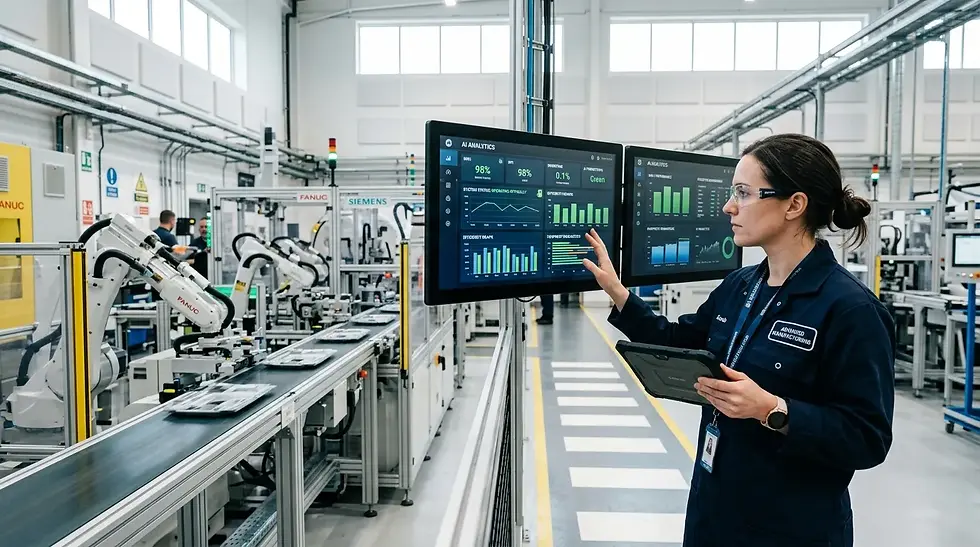
Smart Data Center: An Intelligent Data Center for Autonomous Management of Energy and IT

A smart data center is no longer a “nice to have”.
When energy demand, AI workloads, resilience requirements, and sustainability targets rise at the same time, operating a facility with separate energy and IT silos becomes inefficient—and risky. A Smart Data Center brings these worlds together: it continuously measures what happens in the power chain, cooling, and IT stack, then uses analytics and automation to optimize performance in near real time—safely, with governance and guardrails.
Score Group — where efficiency embraces innovation…
At Score Group, we act as a global integrator across three pillars—Energy, Digital, and New Tech—to help organizations modernize data center operations with a pragmatic, secure, and measurable approach.
Why Smart Data Centers matter now (energy, AI, and operational pressure)
Data centers have become a material driver of electricity demand. The International Energy Agency (IEA) notes that after consuming an estimated 460 TWh in 2022, global data centers’ electricity consumption could reach more than 1,000 TWh in 2026 (depending on scenario and constraints). (<a href="https://www.iea.org/reports/electricity-2024/executive-summary?utm_source=openai" target="_blank" rel="noopener noreferrer">iea.org</a>)
The acceleration is closely linked to digital growth and AI. In its 2025 special report Energy and AI, the IEA models global data center electricity consumption at around 415 TWh in 2024, with the potential to rise to around 945 TWh by 2030. (<a href="https://www.iea.org/reports/energy-and-ai/?utm_source=openai" target="_blank" rel="noopener noreferrer">iea.org</a>)
In the United States specifically, the IEA attributes a major share of demand growth to data centers—estimating around 180 TWh of electricity consumption in 2024 (and further increases through 2030). (<a href="https://www.iea.org/reports/electricity-mid-year-update-2025/demand-global-electricity-use-to-grow-strongly-in-2025-and-2026?utm_source=openai" target="_blank" rel="noopener noreferrer">iea.org</a>)
and about 1.56 (
for the largest data center owned/operated by survey respondents
What a “Smart Data Center” really means (beyond monitoring)
A Smart Data Center is an instrumented, integrated, and intelligent facility where energy and IT operations are managed as one system. The goal is not automation for its own sake; it is autonomous management—the ability to continuously optimize, detect anomalies early, and trigger controlled actions under defined policies.
From “visibility” to “autonomy”: the core capabilities
Full-stack telemetry: power (UPS, generators, PDUs), cooling (chillers/CRAH/CRAC), environmental sensors, racks, servers, network, storage, virtualization, and applications.
Unified data model: a “single source of truth” that correlates facility signals with IT workload behavior.
Analytics & AI: forecasting, anomaly detection, root-cause hints, and optimization recommendations.
Orchestration & automation: runbooks, policy-based controls, and closed-loop optimization with human override.
Governance & security: segmentation, least privilege, audit trails, and safe operational boundaries.
Score Group’s tripartite approach: Energy + Digital + New Tech
At Score Group, the Smart Data Center approach is naturally aligned with our three pillars:
Energy with our division Noor Energy (energy monitoring, optimization, building management, and broader energy strategy).
Digital with our division Noor ITS (data center design/optimization, IT infrastructure, cybersecurity, and resilience).
New Tech with our division Noor Technology (AI, advanced analytics, automation, and connected sensors/IoT).
This architecture avoids a common pitfall: deploying smart tools that remain isolated (a DCIM on one side, an EMS/BMS on the other, and IT observability elsewhere). Instead, we build an operational chain where energy and IT decisions reinforce each other.
Reference architecture for autonomous management of Energy and IT
Autonomy is not a single product—it is a system design. Below is a practical way to structure an “intelligent data center” stack.
Smart Data Center building blocks (and what they enable)
Layer | What it includes | Typical autonomous outcomes | How Score Group supports |
|---|---|---|---|
Instrumentation | Sub-metering, UPS telemetry, thermal sensors, rack PDUs, network & server metrics | Reliable baseline, anomaly signals, granular accountability | Noor Energy (metering/energy), Noor ITS (infrastructure instrumentation) |
Integration | DCIM, BMS/EMS, IT monitoring, CMDB alignment, time-series storage | Correlation between workload and facility load | Noor ITS (data center & IT integration), cross-pillar governance |
Intelligence | Forecasting, anomaly detection, optimization models, digital twin logic | Predictive maintenance, proactive capacity planning | Noor Technology (AI/analytics) + Noor Energy/ITS domain expertise |
Orchestration | Policy engine, automation runbooks, change workflows, controlled actuation | Closed-loop control (with guardrails), faster incident response | Noor Technology (automation), Noor ITS (operations process & resilience) |
Governance & Security | Zero trust principles, segmentation, RBAC/MFA, logging, incident handling | Safe automation, auditable actions, cyber-resilient operations | Noor ITS (cybersecurity, PRA/PCA), shared operational governance |
Autonomous energy management: optimize without compromising uptime
Autonomous energy management starts with measurement discipline and ends with controlled optimization. It must be continuous (not a quarterly audit) and context-aware (cooling and power decisions depend on IT load, ambient conditions, and redundancy state).
Through our division Noor Energy, Score Group supports organizations in building an energy management foundation—monitoring, steering, and optimization—aligned with operational constraints. Learn more about our approach to energy management and consumption optimization.
Examples of “smart” energy use cases
Cooling optimization from real inlet temperatures: using sensor grids to reduce overcooling, while keeping recommended operating envelopes.
Peak shaving strategies: combining operational scheduling with electrical constraints (where applicable), always respecting redundancy requirements.
Predictive maintenance: detecting abnormal patterns (e.g., fan power drift, chiller efficiency degradation) before alarms become incidents.
Energy-aware capacity planning: forecasting future load and identifying where additional IT capacity will create disproportionate facility overhead.
Autonomous IT operations: observability, resilience, and secure-by-design automation
Smartness must also apply to IT operations: workload placement, performance stability, incident response, and continuity planning. This is where the data center becomes an operational platform, not just a building with servers.
With our division Noor ITS, Score Group supports data center design and optimization initiatives, including infrastructure modernization. Explore our dedicated page on data center performance, security, and storage.
Autonomy is only sustainable if the foundations are solid: standardization, lifecycle management, network and server reliability, and maintainability. See our approach to IT infrastructure (networks, servers, and storage).
Cybersecurity: autonomy increases the need for control
When you connect facility systems (often close to OT) with IT monitoring and automation, you increase the attack surface. That does not mean “don’t integrate”—it means integrate securely with segmentation, least privilege, and strong authentication.
Our division Noor ITS provides cybersecurity services covering audits and protection mechanisms. Learn more about cybersecurity (audits, intrusion tests, and strong authentication).
For incident handling, many organizations align their processes with established guidance such as NIST’s Computer Security Incident Handling Guide (SP 800-61 Rev. 2, published in August 2012). (<a href="https://csrc.nist.gov/pubs/sp/800/61/r2/final?utm_source=openai" target="_blank" rel="noopener noreferrer">csrc.nist.gov</a>) You can access it from the NIST Computer Security Resource Center.
Resilience: autonomy needs continuity planning
Automation can reduce human reaction time, but continuity still requires tested recovery scenarios. A Smart Data Center should tie together monitoring, change management, and recovery plans so that the organization remains resilient under both technical failures and cyber incidents.
Score Group supports resilience initiatives through Noor ITS. Discover our approach to PRA/PCA (IT disaster recovery and business continuity).
AI and automation: how to make the loop truly “intelligent”
In practice, “autonomous management” is a continuum. AI and automation help move from reactive operations to proactive and preventive actions—provided you implement them with governance, explainability, and safety constraints.
At Score Group, our division Noor Technology focuses on operational AI use cases such as anomaly detection and predictive analytics. Learn more about our work in Artificial Intelligence (multimodal AI and anomaly detection).
Concrete AI-driven scenarios (without unsafe “autopilot”)
Anomaly detection on cooling efficiency: AI spots a deviation between IT load and cooling power that historically indicates fouling, valve drift, or control instability, and triggers a maintenance workflow.
Thermal-aware workload steering: recommendations (or controlled actions) that reduce hotspots by shifting non-critical workloads, while preserving SLAs and redundancy constraints.
Predictive risk scoring: combining alarms, vibration/temperature patterns, and maintenance history to prioritize interventions on the most critical assets (UPS strings, pumps, CRAHs).
Automated runbooks: when a known condition is detected, the system executes an approved sequence (notify, isolate, fail over, validate), then logs the full action trail.
Metrics and standards that anchor a Smart Data Center program
A Smart Data Center program needs shared KPIs across facilities and IT, otherwise each team optimizes locally. These are some of the most useful anchors.
Operational KPIs: what to track, and why
KPI / Standard | What it helps you manage | How it becomes “smart” |
|---|---|---|
PUE (Power Usage Effectiveness) | Facility overhead vs. IT load | Real-time PUE by zone, correlated with workload type and ambient conditions |
Thermal envelope (ASHRAE guidance) | Reliability vs. overcooling risk | Control based on real server inlet temperatures (not only room averages) |
ISO 50001 (energy management) | Continuous improvement cycle for energy performance | Structured baselines, action plans, measurement plans, and governance |
Availability / MTTR / change success rate | Operational reliability | Automation reduces detection-to-action time and standardizes responses |
Capacity headroom (power, cooling, space) | Growth planning without overbuild | Forecast models anticipate constraints and propose staged upgrades |
ASHRAE thermal guidance: commonly referenced recommended server inlet temperature guidance for many classes is 18°C to 27°C (with allowable ranges depending on equipment class). (<a href="https://datacenters.lbl.gov/sites/default/files/USER%20GUIDE%20FOR%20IMPLEMENTING%20ECBC_v9.2_06_May%202021_0.pdf?utm_source=openai" target="_blank" rel="noopener noreferrer">datacenters.lbl.gov</a>) (For an accessible reference card, see the ASHRAE supplemental reference card.)
ISO 50001: for organizations looking to formalize continuous energy performance improvement, ISO describes ISO 50001 as a framework for energy management systems built on continual improvement (not a one-off project). (<a href="https://www.iso.org/iso-50001-energy-management.html?utm_source=openai" target="_blank" rel="noopener noreferrer">iso.org</a>) (See ISO’s overview of ISO 50001.)
Operational best practices: the U.S. Department of Energy provides a comprehensive best-practices guide for energy-efficient data center design (revised July 2024), covering IT, airflow management, cooling/electrical systems, and more. (<a href="https://www.energy.gov/sites/default/files/2024-07/best-practice-guide-data-center-design.pdf?utm_source=openai" target="_blank" rel="noopener noreferrer">energy.gov</a>) (See DOE FEMP guidance.)
Implementation roadmap: how organizations progress toward autonomy
Autonomous management works best when implemented as a maturity journey. A pragmatic roadmap reduces risk and builds trust across facilities, IT, security, and management.
Baseline & instrumentation: validate metering, fill telemetry gaps, standardize naming, align time synchronization.
Integration: connect DCIM/BMS/EMS with IT observability; ensure data quality (calibration, missing values, outliers).
Operational dashboards: build shared KPI views (energy + IT + resilience) and agree on “one version of truth”.
Analytics & AI pilots: start with low-risk, high-value use cases (anomaly detection, forecasting, maintenance prioritization).
Automation with guardrails: implement approved runbooks; begin with “human-in-the-loop”, then expand to closed-loop where safe.
Continuous improvement: governance cadence, lessons learned, model retraining, and ongoing optimization.
Common pitfalls (and how to avoid them)
Chasing PUE alone: optimize for a balanced scorecard (efficiency + reliability + security). A lower PUE is not worth degraded resilience.
Data without decisions: dashboards don’t deliver autonomy; define actions, thresholds, owners, and escalation paths.
Automation without governance: every automated action should be auditable, reversible where possible, and limited by policy constraints.
Ignoring cybersecurity early: integrate security by design (segmentation, MFA, least privilege, monitoring) before expanding connectivity.
Underestimating change management: autonomy changes operating culture—train teams and formalize cross-domain processes.
FAQ: Smart Data Center and autonomous management of Energy & IT
What is the difference between a DCIM and a Smart Data Center?
A DCIM is typically a platform focused on data center infrastructure visibility (capacity, assets, alarms, sometimes workflows). A Smart Data Center is broader: it combines DCIM with energy management (EMS/BMS), IT observability, analytics/AI, and orchestration so the facility can move from “monitoring” to “controlled optimization.” In other words, DCIM can be a component, but autonomy requires data correlation (energy + cooling + IT load) and governance so decisions can be executed safely and consistently.
How can I reduce energy consumption without increasing risk to uptime?
Start by validating measurement and thermal visibility (especially server inlet temperatures), then target inefficiencies that do not reduce redundancy: airflow containment improvements, setpoint optimization within recommended envelopes, and proactive maintenance based on performance drift. Use a staged approach: recommendations first, then “human-in-the-loop” automation for low-risk actions. Align energy KPIs with reliability KPIs (availability, MTTR, change success rate) so the organization never optimizes energy at the expense of continuity.
What data do I need to enable autonomous management of energy and IT?
You need correlated, time-aligned data across power, cooling, environment, and IT. On the facility side: utility and sub-metering, UPS/generator telemetry, PDU/rack power, cooling plant metrics, and temperature/humidity at meaningful points (ideally near server inlets). On the IT side: server and virtualization metrics, workload tags, application performance signals, and incident/change records. The key is a consistent data model (naming, hierarchy, timestamps) so analytics can connect “what the workload did” with “what the facility consumed.”
Is it safe to automate data center operations with AI?
It can be safe—if designed correctly. Use AI first for detection and recommendations (anomaly detection, forecasting, prioritization), then add automation only with explicit guardrails: role-based controls, approval workflows when needed, rollback procedures, and audit logs. Treat facility controls like critical systems: segment networks, enforce strong authentication, and test runbooks as you would test a disaster recovery plan. Autonomy should increase safety by reducing reaction time and human error, not introduce uncontrolled “black box” actions.
How do AI workloads change the way we should operate a data center?
AI often increases power density and can introduce load volatility, which stresses cooling control stability and power distribution planning. It also raises the value of predictive operations: detecting drift in cooling efficiency, forecasting peak demand, and preventing hotspots before they impact hardware. Because the IEA expects significant growth in data center electricity demand through 2030, organizations benefit from managing energy and IT together—linking workload placement decisions to facility constraints, sustainability objectives, and resilience requirements. (<a href="https://www.iea.org/reports/energy-and-ai/?utm_source=openai" target="_blank" rel="noopener noreferrer">iea.org</a>)
What’s next?
If you want to move from isolated monitoring to an intelligent, autonomously optimized data center, Score Group can help you align energy, digital infrastructure, and innovation into one operating model—solutions tailored to each of your needs. Start by exploring our Data Center services and our energy management approach, then reach out via score-grp.com to engage the right experts across Noor Energy, Noor ITS, and Noor Technology.