Will Battery Energy Storage Systems Transform Industry?

Battery energy storage systems are no longer just backup. They are becoming a core flexibility asset for power systems, industrial sites, and digital infrastructure as electrification, solar, and wind reshape demand. The question is no longer whether BESS matters, but how far and how fast it will move from a supporting technology to a strategic layer in industrial operations. (iea.org)
For factories, campuses, utilities, and data centers, the logic is simple: store electricity when the system has room, then release it when demand rises, renewable output falls, or uptime becomes critical. That shift can reduce congestion, smooth peaks, and make energy use more controllable. In that sense, BESS is less a battery room than an operating model for a more variable grid.
At Score Group, this is exactly the kind of systems thinking our Noor Energy division applies to energy performance: connect the load, the equipment, and the operating context so storage is not isolated, but integrated into a broader efficiency strategy.
What BESS actually does
A battery energy storage system does not create electricity from fuel. It stores electricity that has already been generated and delivers it later, often in short bursts or over a few hours. The U.S. Energy Information Administration notes that battery systems can provide rapid response on sub-hourly timescales, while the IEA highlights their role in short-term flexibility for periods of roughly one to eight hours. (eia.gov)
That distinction matters. A BESS is not the same as a generator, and it is not only a backup UPS. It can support frequency response, peak shaving, renewable shifting, and resilience, depending on how it is sized and controlled. For industrial users, the value comes from timing as much as capacity.
In practical terms, BESS is becoming a fast-response flexibility layer for the power system: it helps balance supply and demand, reduce congestion, and support critical loads when the grid becomes less predictable.
Why the case for BESS is getting stronger
The market is scaling quickly. According to the IEA, utility-scale battery storage additions reached 63 GW in 2024, bringing total installed capacity to 124 GW. In 2025, global battery storage additions rose to 108 GW, and installed capacity became eleven times higher than in 2021. The same IEA analysis says lithium-iron phosphate, or LFP, batteries accounted for around 90% of deployments in 2025. (iea.org)
Costs are also moving in the right direction. The IEA reports that battery storage project costs fell by about 40% in 2024 to around USD 150/kWh, which helps explain the pace of deployment. In the United States, EIA data showed cumulative utility-scale battery storage capacity exceeded 26 GW in 2024, with 10.4 GW added that year alone.
Market signals that matter most
Signal | What it means | Why industry should care |
|---|---|---|
63 GW added globally in 2024. | BESS is already moving into mainstream infrastructure planning. | Industrial users can no longer treat storage as a pilot-only technology. |
108 GW added globally in 2025. | Deployment accelerated sharply in just one year. (iea.org) | Supply chains, engineering know-how, and financing structures are maturing. |
Costs fell about 40% in 2024. | The economics improved materially in a single year. | More sites can build a credible business case around flexibility and resilience. |
U.S. installed capacity passed 26 GW in 2024. | One of the largest power markets is scaling storage fast. (eia.gov) | Industrial planners can benchmark against a large, active deployment market. |
Where BESS changes industry the most
BESS does not transform every business model in the same way. Its biggest impact appears where power is expensive, variable, or mission-critical. That is why the strongest cases are often found in manufacturing, logistics hubs, data centers, commercial campuses, and hybrid renewable sites.
Peak shaving and load shifting
For sites with sharp demand peaks, storage can discharge when power draw is highest and recharge when demand is lower. That smooths the load profile and helps reduce stress on electrical infrastructure. At Score Group, our energy management services are built around the same principle: measure demand, understand peaks, and optimize how energy is used across the site.
This matters because industrial energy costs are not just about total consumption. They are also about when and how that consumption happens. A battery can help turn irregular consumption into a more manageable operating pattern.
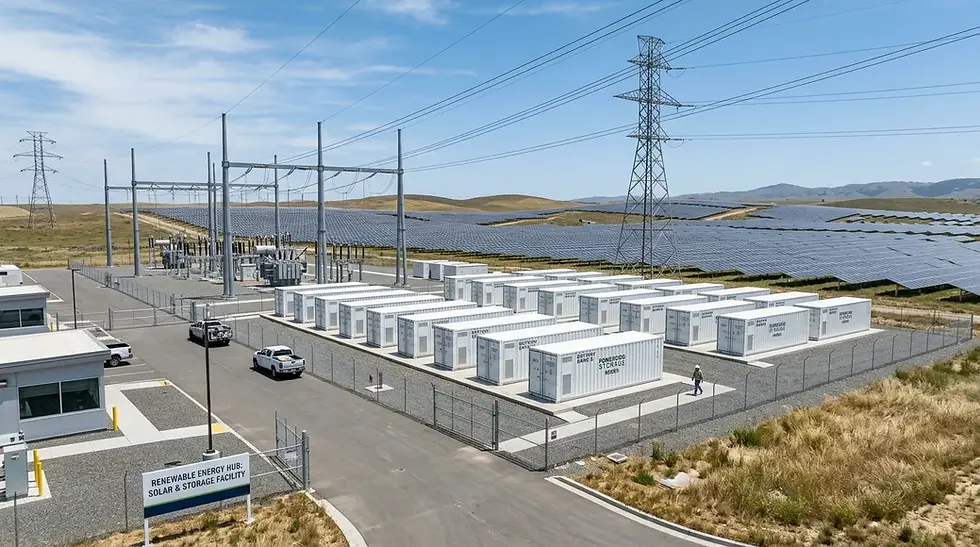
Renewable integration and hybrid plants
BESS makes solar and wind more useful by storing excess output and releasing it later, which helps align generation with demand. NREL notes that energy storage is one of the key flexibility options for integrating renewable resources, and the IEA says batteries support the secure and cost-effective integration of variable demand and supply. This is also why hybrid architectures are gaining momentum; the rise of hybrid energy infrastructures shows how grid, solar, and batteries can operate as one system.
For businesses that already invest in on-site generation, storage can raise self-consumption and reduce dependence on a single source of power. That can improve predictability, especially where production schedules are sensitive to interruptions or price volatility. (nrel.gov)
Resilience for critical infrastructure
When uptime is non-negotiable, BESS can keep critical circuits alive during disturbances and help facilities recover faster. The U.S. Department of Energy says resilient grid systems use local resources such as solar panels and battery storage to quickly reconfigure power flows and restore electricity services during a disturbance. For mission-critical environments, the data center infrastructure discussion is especially relevant because power quality and continuity are part of operational performance, not just an IT issue. (energy.gov)
Digital control and better dispatch
The value of a battery depends heavily on control. Forecasting, automation, and monitoring determine when the battery charges, when it discharges, and which service it prioritizes. That is where software, analytics, and connected devices matter. Score Group’s NOOR-Technology division fits naturally into this layer, because BESS becomes far more effective when it is managed with real-time data and automated decisions.
In the IEA’s latest analysis, battery storage is also becoming important for new large loads such as data centers, where consumption can be highly correlated across location and time. That makes digital control part of the energy conversation, not a separate topic.
What is slowing adoption?
Even with strong momentum, BESS still faces practical barriers. The IEA says regulators need to recognize the full value of battery services, enable market access, and create price signals that reflect the technology’s contribution. The U.S. EPA also stresses siting, zoning, marking, and permitting requirements for safe installations. In other words, the technology may be ready before the market framework is fully ready for it. (iea.org)
Market design: storage must be paid for the services it provides, not only for one narrow use case.
Safety and permitting: engineering, fire safety, and local approval processes can affect timelines. (epa.gov)
Revenue stacking: the business case is stronger when a battery can support multiple services over its lifetime.
Operating discipline: value depends on dispatch strategy, maintenance, and digital control.
So the challenge is not just installing batteries. It is integrating them into the site’s energy, safety, and digital architecture so they keep delivering value after commissioning.
So, will BESS transform industry?
Yes, but in a specific way. BESS will not replace all other energy assets, and it will not solve every grid problem. What it will do is change how industrial and utility players think about flexibility, resilience, and the timing of electricity use. The biggest winners will be organizations that combine batteries with renewables, automation, and a clear operating model. That is an inference drawn from the IEA, NREL, DOE, and EPA sources above.
In practice, transformation happens when BESS becomes part of an integrated system: energy management, site controls, grid interaction, and resilience planning. That is where the technology moves from “nice to have” to “strategic infrastructure.”
FAQ
How will battery energy storage systems transform the electricity industry?
BESS will transform the electricity industry by making flexibility a controllable asset. Instead of relying only on generation, grids can store electricity and use it later to balance demand, support renewable integration, and reduce congestion. The IEA says battery storage is well suited to short-term flexibility over one to eight hours, and its analysis shows deployment is scaling quickly as costs fall. In practice, that means batteries become part of the grid’s operating logic, not just an add-on.
Will BESS technology change the way utilities manage the grid?
Yes. Utilities can use BESS for peak management, frequency support, local congestion relief, and faster response to changing load conditions. NREL describes energy storage as one of the key flexibility options for integrating renewable energy resources, while the IEA notes that batteries can help defer some grid investment and improve system efficiency. That gives utilities more operational tools and more room to manage variability without depending solely on new fossil-fuel peaking assets.
What are the main drivers for battery energy storage systems transforming the energy sector?
The strongest drivers are falling costs, rising renewable generation, electrification, resilience needs, and new demand from large loads such as data centers. The IEA reports that battery storage project costs fell by about 40% in 2024 to around USD 150/kWh, while global deployments accelerated in 2025. It also highlights the importance of batteries for data centers and other highly correlated loads. Together, these forces make storage more attractive across both utility and industrial use cases.
How does BESS enable integration of renewable energy on the grid?
BESS enables renewable integration by absorbing excess solar or wind power when generation exceeds demand and releasing that energy when the system needs it most. NREL notes that storage is a key flexibility option for integrating variable resources, and the IEA says batteries help shift supply to periods of higher demand while reducing losses and congestion. This improves the practical value of renewables, especially in grids with high shares of intermittent generation.
What are the barriers to BESS adoption transforming the power industry?
The main barriers are market design, permitting, safety, and the need to build a credible revenue stack. The IEA says regulators must recognize the full value of battery services and allow market access that reflects those services. The U.S. EPA also points to siting, zoning, marking, and permitting requirements for safe installation. Even when batteries are technically ready, these non-technical issues can slow projects and reduce certainty for investors.
What comes next?
If you are planning how storage, energy management, and digital control should work together on your site, explore Score Group’s homepage and our Noor Energy division. Together, they show how storage can fit into a wider operating model focused on performance, resilience, and efficiency.