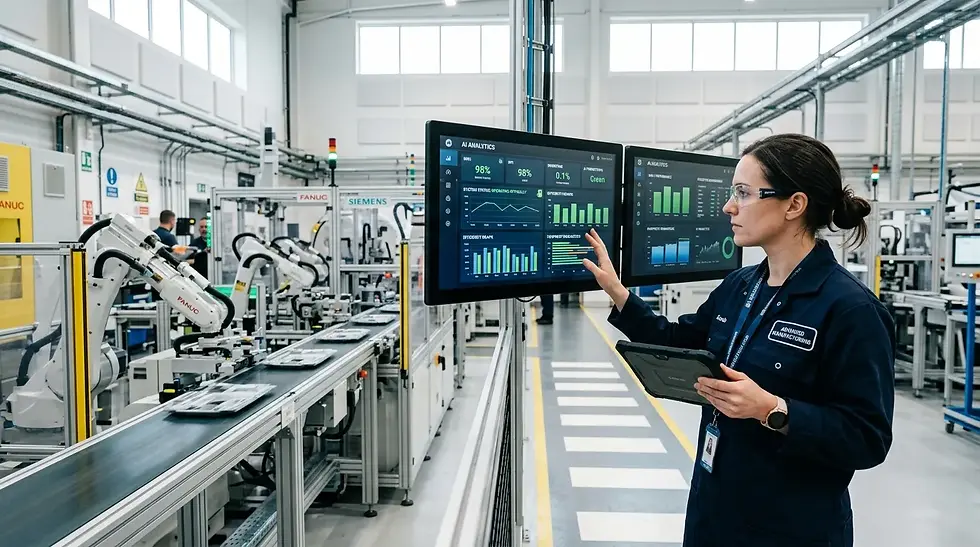
AI-Powered IT Operations (AIOps²): Where Efficient IT Meets Smart Energy
Updated: Jan 5

Reinventing IT operations with AI and energy intelligence
AI-powered IT Operations AIOps² is about turning noisy, reactive IT into a proactive, self-optimising engine for your business.
Today’s infrastructure is hybrid, distributed and always-on. A single outage can cost hundreds of thousands of dollars per hour when critical systems go down, especially for large enterprises and digital-native businesses.erwoodgroup.com At the same time, data centres already account for roughly 1–2% of global electricity use and are expected to more than double their consumption by 2030, with AI as a key driver.iea.org
In this context, traditional monitoring and manual operations are no longer enough. Organisations need intelligent operations that can see across silos, act in real time and factor in not only performance, but also energy, cost and sustainability.
At Score Group, we call this expanded vision AIOps²: AI-augmented IT operations, squared with energy and new technologies, across our Noor ITS, Noor Energy and Noor Technology divisions.
What do we mean by AIOps and AIOps²?
In the IT world, AIOps (Artificial Intelligence for IT Operations) describes platforms that combine big data, machine learning and analytics to automate tasks like event correlation, anomaly detection and root-cause analysis across complex environments.gartner.com Rather than relying on humans to sift through logs and dashboards, AIOps engines continuously learn from telemetry and take context-aware actions.
AIOps² builds on this foundation but extends the perimeter in two directions that are core to Score Group’s DNA:
Digital & infrastructure (Noor ITS) – networks, systems, cloud, security, datacenters, PRA/PCA and digital workplace.
Energy & building intelligence (Noor Energy) – smart buildings, metering, GTB/GTC, mobility and renewables.
New technologies (Noor Technology) – AI/ML, RPA, IoT and bespoke applications.
With AIOps², AI doesn’t just keep servers healthy. It optimises the full chain—from IT infrastructure to energy consumption and user experience—so operational efficiency and sustainability progress together.
Core capabilities of AI-powered IT operations
Unified observability and data ingestion at scale
AIOps² starts with data. Modern IT environments generate metrics, logs, traces, tickets, alerts, configuration changes, IoT sensor data and energy readings. Instead of analysing these streams in isolated tools, an AIOps approach aggregates them into a common data fabric:
Telemetry from infrastructure (servers, network, storage, cloud, containers).
Application performance and user experience signals.
ITSM data (incidents, changes, problems, CMDB).
Environmental and energy data from datacenters and buildings (GTB/GTC, meters, BMS).
Our Noor ITS division focuses on building this observability layer—covering on-premises, cloud and edge—while Noor Energy brings in energy and building data so you can correlate IT health with power, cooling and occupancy patterns.
Noise reduction and intelligent event correlation
Operations teams are often buried under thousands of alerts per day. AIOps engines cut through this noise by:
Clustering related alerts into single, enriched incidents.
Identifying patterns that precede outages (for example, a specific sequence of network events before a switch failure).
Surfacing only the most relevant anomalies, based on learned behaviour.
Gartner defines AIOps platforms as tools that ingest high-volume, high-velocity IT operations data and apply machine learning to detect patterns and derive insights, reducing manual analysis time and error rates.gartner.com In an AIOps² model, we extend this correlation to energy and environmental events—for instance, tying temperature spikes in a room to performance degradations or power-capping policies.
Predictive incident management and self-healing
Instead of reacting to incidents when users complain, AI-powered IT operations aim to predict and prevent them. Typical capabilities include:
Predictive alerts – early warnings when key indicators deviate from healthy baselines.
Automated runbooks – playbooks triggered by AI-detected conditions (restart services, roll back configurations, scale out capacity).
Self-healing workflows – closed-loop automation where the system not only detects but also validates and executes remediation, then confirms success.
According to recent observability studies, organisations deploying AIOps and related AI-monitoring capabilities report lower outage costs and shorter detection times compared with those relying on manual approaches alone.newrelic.com
Capacity, cost and energy optimisation
One of the most powerful—but underused—benefits of AIOps is its ability to optimise resources holistically.
Right-sizing infrastructure based on observed workloads instead of static sizing.
Scheduling non-critical batch jobs or backups during off-peak energy periods.
Adjusting cooling and power profiles dynamically based on IT load forecasts.
International agencies now estimate that data centres could consume close to 3% of global electricity by 2030, with AI workloads contributing significantly to the increase.datacenterdynamics.com Noor Energy’s expertise in intelligent energy management allows AIOps² to treat electricity, cooling and carbon as first-class optimisation variables alongside CPU and memory.
Security, resilience and PRA/PCA integration
As infrastructure becomes more automated, resilience and security cannot be afterthoughts. Noor ITS integrates AIOps² with:
Security monitoring and anomaly detection (for example, unusual east–west traffic patterns).
Disaster recovery and business continuity plans (PRA/PCA), using AI to simulate failure scenarios and optimise recovery plans.
Automated configuration drift detection and compliance checks.
The result is an operations model where uptime, security posture and continuity are constantly assessed and improved in near real time.
Traditional IT operations vs AIOps²
Dimension | Traditional IT Operations | AI-powered IT Operations (AIOps²) |
|---|---|---|
Monitoring | Tool-specific dashboards, limited cross-correlation, mostly manual analysis. | Unified observability with automated correlation across IT, energy and IoT data. |
Incident management | Reactive; incidents detected by user complaints or threshold breaches. | Predictive; anomalies detected early, with automated triage and runbooks. |
Alert volume | High noise; teams overwhelmed by redundant and low-value alerts. | Alerts clustered into enriched incidents; noise reduced by machine learning. |
Energy & sustainability | Handled separately by facilities/energy teams, often with minimal IT context. | Energy usage, cooling and carbon footprint optimised alongside IT capacity. |
Human workload | Focus on repetitive tasks and firefighting, limited time for innovation. | Automation handles routine operations; teams focus on strategy and improvements. |
Business impact | Hard to quantify; limited linkage from incidents to revenue or ESG metrics. | Incidents and changes tied to SLAs, costs, energy and ESG indicators. |
How Score Group delivers AIOps² with Noor divisions
1. Strategy and assessment
Every organisation starts from a different point. At Score Group, we begin with a structured assessment that brings together stakeholders from IT, operations, facilities and the business:
Map existing infrastructure, tools and processes (monitoring, ITSM, PRA/PCA, GTB/GTC).
Identify the most critical services and their current incident and downtime profile.
Assess data quality and availability (logs, metrics, tickets, energy data).
Define clear business objectives for AIOps² (for example, reduce mean time to resolution, cut energy costs in the datacenter, improve end-user experience).
Our Noor ITS division focuses on the IT operations baseline, Noor Energy assesses energy performance and building systems, while Noor Technology evaluates where AI, RPA and IoT can add the most value.
2. Architecture and platform integration
Score Group acts as a global integrator rather than a single-vendor platform provider. This means we help you:
Select and integrate observability, AIOps and automation platforms that fit your context.
Connect data sources—IT infrastructure, applications, security, energy meters, IoT sensors—into a coherent architecture.
Design reference architectures for datacenters, cloud and edge sites aligned with your resilience and compliance requirements.
Our Noor ITS experts orchestrate the underlying infrastructure and connectivity, while Noor Technology designs the AI models, automation workflows and application integrations that turn raw data into actionable intelligence.
3. Use-case-driven implementation
Instead of “boiling the ocean”, AIOps² projects should focus on a small number of high-impact use cases first, such as:
Reducing time to detect and resolve critical incidents on a flagship application.
Optimising cooling and power in a primary datacenter without compromising reliability.
Automating common service desk requests using AI and RPA.
Our teams co-design these scenarios with you, implement the required data flows, build AI models and automation runbooks, then iterate based on measurable outcomes.
4. Change management, skills and governance
AI-powered operations change how teams work. To ensure adoption, Score Group supports you with:
Training for IT, facilities and business stakeholders on AIOps² concepts and tools.
Coaching on new roles (site reliability engineering, automation owners, data stewards).
Governance frameworks for model validation, automation safety and incident review.
This holistic approach ensures AI augments teams rather than replacing them, building trust in the new operating model.
Concrete AIOps² use cases across energy, digital and new tech
Smart datacenter and building operations
For organisations running their own sites or hybrid environments, Noor Energy and Noor ITS can jointly implement AIOps² scenarios such as:
Dynamic adjustment of cooling setpoints based on IT load forecasts and external temperatures.
Automatic rebalancing of workloads to avoid hot spots and reduce energy peaks.
These use cases align with global efforts to make data centres more energy-efficient and “green”, where optimisation of power and cooling is becoming a competitive advantage as electricity demand rises.socomec.us
Digital workplace and service desk automation
In the digital workplace, Noor ITS and Noor Technology combine AIOps and RPA to improve employee experience:
AI assistants that troubleshoot common issues (VPN, Wi-Fi, collaboration tools) before a ticket is opened.
Automatic classification and routing of incidents based on historical resolution patterns.
Robotic processes handling repetitive tasks like account provisioning or access reviews.
As a result, service desks spend less time on level-1 tasks and more on complex issues, while employees get faster, more consistent support.
Industrial, IoT and smart assets
For manufacturing, utilities or logistics, Noor Technology and Noor Industry (when applicable) can apply AIOps² principles to operational technology and IoT:
Aggregating sensor data from machines, lines or assets into a common data platform.
Using predictive models to anticipate failures and trigger maintenance before breakdowns.
Coordinating actions across IT and OT—for example, gracefully degrading non-critical IT workloads to preserve power for essential production assets during peaks.
This convergence of IT, OT and energy intelligence is essential as more industrial operations become software-defined and connected.
Sustainable IT and ESG reporting
Regulators, customers and investors increasingly ask detailed questions about digital sustainability. AIOps² can help by:
Linking IT resources to carbon intensity data for different energy sources.
Producing reports on the energy and emissions profile of specific applications or services.
Simulating the impact of consolidation, cloud migration or hardware refreshes on energy and emissions.
Noor Energy’s energy expertise, combined with Noor ITS’s infrastructure knowledge and Noor Technology’s data and AI capabilities, provides the foundation for credible, auditable ESG metrics for your digital estate.
Building your AIOps² roadmap: practical steps
Whether you are just starting with AI in operations or already piloting tools, a structured roadmap helps maximise value:
Clarify your objectives – for example, reduce high-impact outages by X%, cut energy use in IT facilities by Y%, or improve employee satisfaction with IT services.
Inventory your data and tools – understand where observability gaps exist (logs, metrics, energy data, tickets, CMDB accuracy).
Prioritise 2–3 high-impact use cases – choose cases that combine technical feasibility and measurable business benefits.
Design an architecture with future growth in mind – avoid locking into a narrow, tool-specific view; plan for multi-cloud and edge.
Start small, measure, iterate – run limited pilots with clear KPIs, then industrialise what works.
Invest in people and processes – AIOps² succeeds when teams evolve their practices, not just their tools.
Score Group can support you through each step, from diagnostic workshops to full-scale integration and run.
FAQ about AI-powered IT Operations (AIOps²)
What is AIOps² in simple terms?
AIOps² is an evolution of classic AIOps. Traditional AIOps uses AI and machine learning to improve IT operations: it analyses logs, metrics and events to detect problems faster and automate responses. AIOps² goes further by including energy, building systems and IoT data in the picture. Instead of optimising only servers and applications, it looks at the whole ecosystem—IT, power, cooling and user experience—and makes coordinated decisions. In practice, that means fewer outages, better performance and lower energy consumption, all managed through a unified, AI-augmented operations layer.
How is AI-powered IT operations different from standard monitoring tools?
Standard monitoring tools collect metrics and raise alerts when thresholds are breached, but they typically operate in silos and rely on human operators to interpret signals. AI-powered IT operations use AIOps platforms to ingest much larger volumes of heterogeneous data, automatically correlate events and learn what “normal” looks like across your environment. Instead of hundreds of isolated alerts, you get a small number of enriched incidents with likely root causes and recommended actions. Over time, the system can trigger automated runbooks so common problems are resolved without manual intervention, freeing your teams for higher-value work.
Will AIOps² replace my IT operations team?
No. AIOps² is designed to augment your teams, not replace them. AI is very good at spotting patterns in large datasets and executing well-defined, repetitive tasks. People are better at understanding business priorities, handling exceptions, designing architectures and communicating with stakeholders. In a mature AIOps² model, your team spends less time firefighting and more time improving reliability, security and user experience. New roles often emerge, such as SREs (site reliability engineers), automation owners and data stewards, who work together to continuously refine models, runbooks and governance.
How long does it take to see results from an AIOps² initiative?
Timelines vary, but many organisations see tangible benefits within a few months if they focus on targeted use cases. A typical first phase—assessment, design and a pilot on one or two critical services—can run for three to six months. During this time, you can measure improvements in metrics such as mean time to detect, mean time to resolve, number of incidents or energy consumption for a specific site. Scaling AIOps² across your full estate is a multi-year journey, but the approach is incremental: each new use case builds on the data, models and automations you have already deployed.
How does AIOps² contribute to greener, more energy-efficient IT?
AIOps² makes energy and sustainability data as visible and actionable as performance metrics. By combining IT telemetry with building management and metering data, the platform can identify when resources are over-provisioned, when cooling is excessive for the actual load, or when workloads could be shifted to lower-carbon times or locations. It can propose or execute actions such as right-sizing infrastructure, consolidating underused servers or adjusting setpoints. Over time, this continuous optimisation reduces electricity use, cooling needs and related emissions, supporting your ESG commitments while also lowering operating costs.
What’s next?
If you want your IT operations to be smarter, more resilient and more sustainable, now is the right time to explore AIOps². At Score Group, our Noor ITS, Noor Energy and Noor Technology divisions work together to design and integrate solutions tailored to your context—across infrastructure, energy and new technologies. Start by identifying a critical service or site where outages or energy use are a concern, and consider how AI and automation could change the equation. To discuss your situation and define a roadmap, you can reach out to our teams via the contact options available on our website.