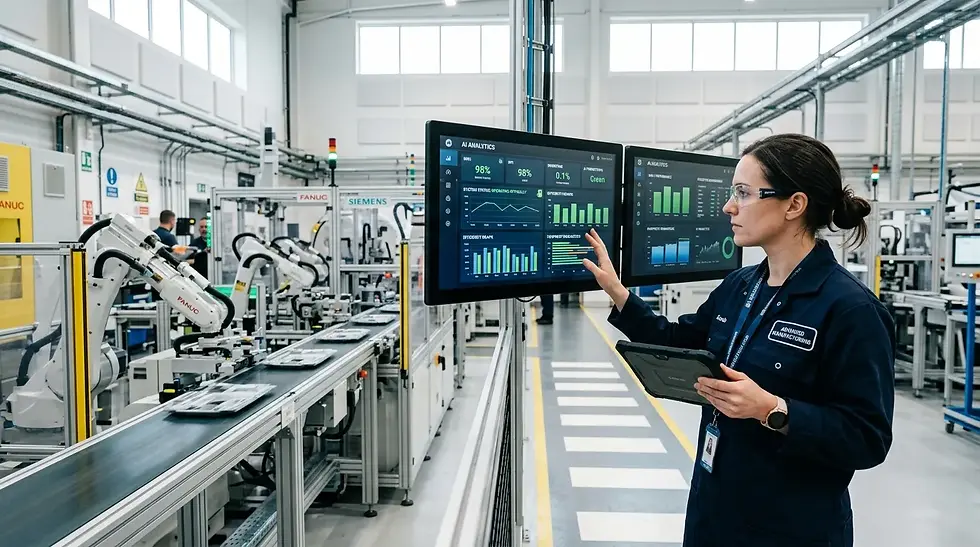
Smart Batteries 4.0 for Data Centers: Intelligent Energy for Always‑On Infrastructure
Updated: Jan 5

Why Smart Batteries 4.0 Are Becoming Critical for Data Centers
Data centers cannot afford to go dark.
Power interruptions, grid instabilities and rising energy costs are now everyday challenges for operators. At the same time, regulatory and corporate pressure to reduce carbon emissions is accelerating. Intelligent, connected “Battery 4.0” systems give data centers a new way to secure uptime, optimize energy use and support sustainability objectives.
At Score Group, we bring together energy, digital infrastructure and new technologies through our Noor Energy, Noor ITS and Noor Technology divisions. This integrated approach allows us to design and deploy smart battery architectures that are fully aligned with your IT, facilities and business continuity strategies.
What Do We Mean by “Smart Batteries 4.0” for Data Centers?
Smart Batteries 4.0 go far beyond traditional UPS batteries. They combine advanced electrochemistry with sensors, connectivity and software intelligence to transform batteries into active, controllable assets in the data center energy ecosystem.
From Static Backup to Intelligent Energy Asset
In many legacy facilities, battery banks sit idle until a failure occurs. They are difficult to monitor in real time and are often oversized “just in case.” In contrast, a modern intelligent storage system typically integrates:
High-performance battery chemistry (often lithium-ion or LFP) offering higher energy density and longer lifecycle than lead-acid.
Battery Management System (BMS) for cell-level monitoring, safety, and balancing.
Power electronics and UPS integration for fast, seamless transfer and grid interaction.
IoT sensors (temperature, voltage, current, humidity) for granular, real-time health tracking.
Energy Management System (EMS) to orchestrate charging/discharging according to IT load, tariffs and grid signals.
Analytics and AI for predictive maintenance, lifecycle optimization and scenario simulations.
This is what we call the “4.0” dimension: batteries interconnected with IT systems and cloud platforms, capable of learning from data and interacting with the grid, not just reacting during outages.
Key Functionalities of Smart Battery Systems in Data Centers
Continuous health diagnostics down to string or cell level.
Predictive replacement planning based on actual usage and aging, not rough rules of thumb.
Peak shaving and load shifting to reduce contracted power and avoid high-tariff periods.
Support for on-site renewables (solar PV, for example) by storing excess production.
Participation in demand response and emerging grid services, when regulations and business models allow.
API integration with DCIM, BMS/GTB and ITSM tools for unified operations.
The Strategic Benefits of Smart Batteries 4.0 for Data Centers
For operators, the value of intelligent storage spans availability, operating cost, sustainability and risk management.
1. Stronger Resilience and Business Continuity
Unplanned downtime in data centers can cost hundreds of thousands of dollars per hour, depending on the industry. Intelligent batteries contribute to resilience by:
Ensuring faster fault detection at string or rack level, reducing the risk of latent failures.
Providing more accurate autonomy calculations based on real-time conditions rather than theoretical capacity.
Supporting graceful load shedding strategies, coordinated with IT and facility teams.
Improving restart and recovery procedures after grid events by providing controlled power ramps.
By combining Noor ITS expertise in data center architectures with Noor Energy’s skills in electrical engineering and energy storage, Score Group designs end-to-end solutions that protect your SLAs and RTO/RPO objectives.
2. Lower Total Cost of Ownership (TCO)
Traditional VRLA batteries often require replacement every 3–7 years depending on operating conditions. Lithium-based systems, correctly managed, can substantially extend lifespan under many profiles, helping reduce replacement cycles and maintenance costs. On top of hardware savings, an Energy Management System can:
Optimize charging strategies to extend battery life and reduce degradation.
Limit oversizing by giving operators confidence in actual, measured autonomy.
Reduce energy bills through peak shaving, load shifting and better use of contractual tariffs.
Score Group’s approach is to quantify these savings based on your real load profile, not generic assumptions, and to align capacity, redundancy and autonomy with your business risk appetite.
3. Energy Efficiency and Sustainability
According to the International Energy Agency, data centers and data transmission networks accounted for an estimated 460 TWh of electricity consumption in 2022, with demand expected to rise significantly by 2030 under many scenarios. Intelligent storage helps mitigate this impact in several ways:
Enabling higher utilization of on-site renewables by storing excess production instead of curtailing it.
Flattening load curves, which supports grid stability and can facilitate integration of more renewable energy at system level.
Providing granular reporting on avoided emissions and energy performance for ESG reporting.
Through Noor Energy, Score Group can combine smart batteries with photovoltaic systems, building management and other efficiency measures as part of a coherent low-carbon roadmap.
4. Data-Driven Operations and Predictive Maintenance
Smart Batteries 4.0 generate large amounts of data on temperature, current, state of charge (SoC), state of health (SoH) and cycling. By connecting this to Noor Technology’s analytics and AI capabilities, operators gain:
Early detection of atypical behavior (e.g. thermal hotspots, abnormal impedance growth).
Prediction of remaining useful life (RUL) to schedule interventions during planned maintenance windows.
Standardized reporting for audits, certifications and internal governance.
Scenario simulation (for example: “What happens if this feed or generator is lost?”).
This turns your battery system into an instrumented, controllable component of your digital infrastructure rather than a black box.
How Smart Batteries 4.0 Integrate with Data Center Infrastructure
Deploying intelligent storage is not just about replacing batteries. It is about integrating energy, IT and operations.
Integration with UPS, Generators and Grid
In most facilities, batteries are a core part of the UPS system, bridging the gap until generators start or power returns. With Smart Batteries 4.0, the energy storage system can also:
Work with multiple UPS topologies (monolithic, modular, distributed).
Support islanded operation of microgrids that combine generators, batteries and renewables.
Provide fast frequency response or other grid support functions where regulations allow.
Interact with advanced transfer schemes between utility feeds, generators and storage.
Noor ITS works alongside Noor Energy to ensure that electrical coordination (short-circuit levels, selectivity, protection settings) remains robust when new storage capabilities are introduced.
Integration with DCIM, BMS/GTB and IT Systems
To deliver full value, Smart Batteries 4.0 must be connected to the systems that operators use every day. This typically includes:
DCIM (Data Center Infrastructure Management) tools for consolidated monitoring and capacity planning.
BMS/GTB (Building Management Systems) to correlate energy data with HVAC, access control and environmental sensors.
ITSM and ticketing platforms for automated incident creation and workflow.
Cloud-based dashboards for remote, multi-site supervision.
Score Group’s Noor Technology division supports the development of integrations, APIs and custom dashboards, while Noor ITS ensures network performance and cybersecurity.
Cybersecurity Considerations for Connected Battery Systems
Because Smart Batteries 4.0 are connected, cybersecurity becomes a design requirement, not an afterthought. Good practice typically includes:
Network segmentation and zero trust principles between OT and IT domains.
Secure protocols and encryption for remote monitoring and control.
Identity and access management with role-based permissions.
Regular vulnerability assessments and patch management aligned with your SOC processes.
With Noor ITS’ cybersecurity expertise, Score Group helps you align intelligent storage projects with your overall security posture and compliance frameworks.
Traditional UPS Batteries vs Smart Batteries 4.0
Comparative overview
Criteria | Traditional UPS Battery Systems | Smart Batteries 4.0 for Data Centers |
|---|---|---|
Role | Passive backup, used only during outages | Active energy asset used for backup and optimization |
Monitoring | Periodic manual checks, limited visibility | Real-time, granular monitoring with alarms and analytics |
Control | On/off behavior, no dynamic dispatch | Programmable charge/discharge profiles, EMS orchestration |
Integration | UPS only, limited integration with IT and building systems | Integrated with UPS, DCIM, BMS/GTB and cloud dashboards |
Lifecycle Management | Time-based replacement, conservative sizing | Condition-based maintenance and RUL prediction |
Contribution to ESG | Difficult to quantify, limited optimization | Supports renewable integration and detailed reporting |
Use Cases for Smart Batteries 4.0 in Different Data Center Profiles
Colocation and Multi-Tenant Data Centers
For colocation operators, service differentiation and SLA performance are crucial. Smart Batteries 4.0 can help by:
Providing transparent resilience metrics to customers (autonomy, redundancy, incident history).
Supporting differentiated service levels where some areas have enhanced backup strategies.
Reducing operating costs, which can improve competitiveness without compromising reliability.
Score Group can assist in building the business case and technical roadmap, aligning energy strategy with commercial offers.
Enterprise and Private Data Centers
Enterprises often operate smaller or distributed facilities, sometimes as part of hybrid cloud strategies. In this context, Smart Batteries 4.0 can:
Improve resilience in sites with weaker grids or higher outage rates.
Support corporate decarbonization programs by enabling more use of on-site renewables.
Enable centralized monitoring of multiple edge or regional sites.
Through Noor ITS, Score Group helps unify infrastructure management across sites, while Noor Energy designs scalable, standardized energy modules.
Hyperscale and Cloud Data Centers
Larger operators typically already invest heavily in energy innovation. For them, the question is less about whether to adopt intelligent storage and more about how to scale it securely and efficiently. Key elements include:
Standardized architectures that can be replicated across many facilities.
Advanced analytics to optimize fleets of batteries across regions.
Integration with corporate energy procurement and grid interaction strategies.
Score Group acts as a global integrator, aligning energy, digital and new technology pillars to support these complex, multi-country deployments.
How Score Group Supports Smart Battery 4.0 Projects
Implementing intelligent storage in data centers is a transformation project that touches multiple teams. Our role at Score Group is to orchestrate this transformation across our divisions.
1. Assessment and Strategy Design
The first step is to understand your current energy and IT landscape, including:
Existing UPS, generator and battery configurations.
Load profiles, redundancy strategies and criticality of applications.
Constraints related to space, cooling, electrical infrastructure and budget cycles.
Objectives in terms of resilience, cost optimization and sustainability.
Our consultants from Noor Energy and Noor ITS work together to produce a roadmap that aligns technical possibilities with your risk and business requirements.
2. Solution Architecture and Technology Selection
Once the strategy is defined, we design detailed architectures that may include:
Choice of battery technologies and form factors (rack-level, containerized, modular blocks).
Configuration of BMS, EMS and control logic.
Integration patterns with DCIM, BMS/GTB and cloud platforms.
Cybersecurity measures consistent with your policies.
Our Noor Technology division can also develop or adapt software components, dashboards and automation workflows to match your operational practices.
3. Deployment, Commissioning and Integration
Implementation requires coordination between energy, IT and operations teams. Score Group manages:
Project planning to minimize risk during cutovers and maintenance windows.
Installation, testing and commissioning of the energy storage system.
Configuration of monitoring, alerting and reporting.
Integration with existing tools and processes, including documentation.
Our goal is to deliver a system that your teams can operate with confidence from day one.
4. Operations, Training and Continuous Improvement
After go-live, the value of Smart Batteries 4.0 depends on how they are used and maintained over time. Score Group offers:
Training for operations teams on both energy and digital aspects.
Ongoing monitoring and support services according to your needs.
Periodic reviews of performance, savings and risk profile.
Support for technology evolution as your infrastructure and business grow.
By leveraging data, we help you continuously refine setpoints, thresholds and strategies to get the most from your intelligent storage assets.
FAQ: Smart Battery 4.0 Solutions for Data Centers
What exactly is a “Smart Battery 4.0” in a data center context?
In a data center, a Smart Battery 4.0 is an energy storage system that combines modern battery technology with connectivity, sensors and software intelligence. Instead of being a static backup component, it continuously exchanges data with UPS, building systems and management platforms. This allows operators to monitor health in real time, predict failures, optimize charging/discharging and even support functions such as peak shaving or renewable integration. The “4.0” label reflects its ability to integrate into digital ecosystems and Industry 4.0-style architectures, not only to deliver power during outages but to contribute actively to overall energy performance.
How do Smart Batteries 4.0 differ from traditional UPS battery banks?
Traditional UPS battery banks mainly provide emergency power and are often monitored in a limited way, with manual inspections and basic alarms. Smart Batteries 4.0 add a battery management system, advanced metering, and an energy management layer. This means you can see detailed state-of-charge and state-of-health values, track each rack or string, and control when and how the system charges or discharges. They also integrate via APIs into DCIM and BMS platforms. In practice, this improves resilience, reduces unnecessary oversizing, extends battery life and creates new possibilities around cost optimization and sustainability.
Can Smart Batteries 4.0 be retrofitted into existing data centers?
Yes, in many cases intelligent storage can be deployed in existing facilities, but the approach depends on your current electrical design and constraints. Retrofitting may involve replacing legacy battery banks within existing UPS systems, adding dedicated storage modules connected to the main distribution system, or a mix of both. A preliminary assessment looks at space, weight, cooling, cable routes and protection devices, as well as IT and network integration. At Score Group, we start with this assessment and then propose a phased plan that minimizes service interruption and aligns with your maintenance windows and lifecycle replacement cycles.
What is the typical ROI of Smart Battery 4.0 projects in data centers?
The return on investment varies widely based on project scope, energy prices, regulatory context and how you operate the system. Financial benefits usually come from several sources: reduced unplanned downtime risk, extended battery life, lower maintenance costs, and savings from peak shaving or tariff optimization. In environments with strong support for demand response or high renewable penetration, additional revenue or avoided costs may be possible. Instead of relying on generic numbers, Score Group builds a customized business case using your historical load curves, tariffs and resilience requirements, allowing decision-makers to evaluate scenarios with transparent assumptions.
How do you secure connected battery systems against cyber threats?
Securing Smart Batteries 4.0 starts with clear segmentation between operational technology and IT networks, limiting the attack surface. Best practice includes using encrypted protocols, strong authentication and role-based access, as well as disabling unnecessary services. Monitoring for anomalies and integrating logs into your SIEM platform helps detect suspicious behavior early. Regular patching, firmware management and vulnerability assessments are also essential. Working through Noor ITS, Score Group incorporates these measures into the design phase, ensuring that intelligent storage systems support your overall cybersecurity strategy instead of becoming a weak point in the architecture.
What’s Next?
If you are exploring how Smart Batteries 4.0 could strengthen the resilience, efficiency and sustainability of your data centers, Score Group can help you move from concept to operation. Our Noor Energy, Noor ITS and Noor Technology divisions collaborate to design and integrate solutions tailored to your infrastructure and business priorities. To learn more about our integrated energy and digital services, visit our website at score-grp.com and contact our teams to discuss your project and next steps.