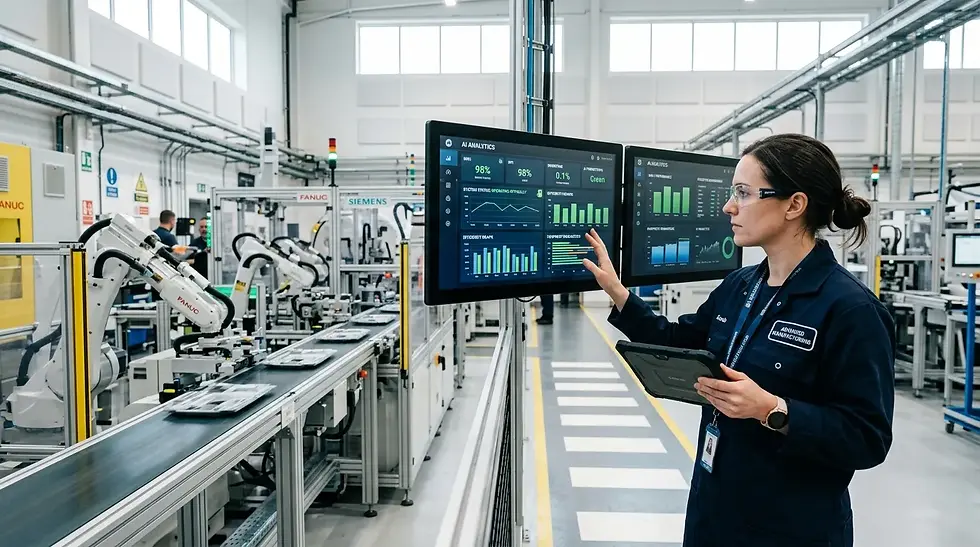
Industry 5.0: Turning Energy from Cost Center into a Driver of Competitiveness
Updated: Jan 5

From Energy Cost to Strategic Advantage
Energy is no longer just a bill to pay.
In the era of Industry 5.0, energy becomes a strategic lever for competitiveness, resilience and innovation. Instead of seeing electricity, gas or fuel only as volatile operating costs, leading organisations are turning their energy systems into engines of productivity, differentiation and sustainable growth.
Industry 5.0, as framed by the European Commission, extends Industry 4.0 by placing sustainability, human-centricity and resilience at the heart of industrial strategy. It asks how industry can create prosperity while respecting planetary boundaries and empowering people — and energy is central to that vision. research-and-innovation.ec.europa.eu
At Score Group, “Where efficiency embraces innovation”, we help organisations make this shift: from energy as an unavoidable expense to energy as a controlled, optimised and value-creating asset.
Why Energy Is the New Battleground for Competitiveness
The industrial sector accounts for around 37% of global final energy use, and this share has increased over the past two decades. iea.org In some energy-intensive sectors, such as metals smelting, energy can represent up to 60% of total operating costs, directly impacting price competitiveness and margins. reuters.com
At the same time, organisations that invest in energy performance see clear benefits. The International Energy Agency (IEA) shows that energy management can generate more than 10% annual energy cost savings within three years, and up to 60% over the longer term, while often delivering at least as much additional value through higher productivity, lower maintenance and better quality. iea.org
A recent IEA survey of 1,000 industrial firms across 14 countries found that around 80% consider energy efficiency critical to their competitive edge, and nearly 40% see it as their first line of defence against rising energy prices. iea.org The World Bank similarly estimates that every dollar invested in energy efficiency can yield three to five dollars in returns, thanks to lower energy needs, reduced infrastructure spending and job creation. worldbank.org
In other words, treating energy purely as a cost is now a strategic mistake. Industry 5.0 invites companies to rethink energy as a lever for:
Cost competitiveness through efficiency, flexible demand and self-generation
Operational excellence via real-time monitoring, predictive analytics and automation
Resilience to market shocks, supply constraints and regulatory change
Sustainability and brand value by reducing emissions and resource use
Talent attraction through safer, smarter and more engaging workplaces
Score Group’s Tripartite Architecture for Industry 5.0
To turn “energy as a cost” into “energy as a competitive asset”, companies need a holistic, integrated approach. At Score Group, we act as a global integrator across three mutually reinforcing pillars:
Energy – intelligent, sustainable and profitable energy management
Digital – secure, scalable and resilient IT infrastructures
New Tech – AI, IoT, automation and advanced applications
Through our divisions Noor Energy, Noor ITS, Noor Technology and Noor Industry, we design and implement bespoke solutions that connect these three pillars to your operational reality.
Noor Energy: Intelligence at the Service of Energy Performance
Our Noor Energy division focuses on making every kWh count – technically, operationally and financially. It brings together four key areas of expertise:
Energy Management: multi-site monitoring, sub-metering, dashboards and analytics to identify and prioritise savings opportunities
Building Management (GTB/GTC and smart systems): intelligent control of HVAC, lighting and technical systems for comfort and efficiency
Sustainable Mobility: charging infrastructure, green fleet strategies and smart charging to limit peak demand and optimise energy use
Renewable Energy: solar PV, self-consumption architectures and storage to reduce exposure to market volatility and decarbonise supply
In an Industry 5.0 logic, Noor Energy’s role is not only to reduce consumption, but to align energy decisions with production, logistics and business priorities.
Noor ITS: Digital Infrastructure as the Backbone of Transformation
Noor ITS ensures that your digital foundations can support Industry 5.0 ambitions. Data-driven energy and operational optimisation are only possible when networks, systems and platforms are robust, secure and interoperable. Our expertise covers:
IT Infrastructure: networks, systems, storage, and maintenance
Cybersecurity: audits, protection strategies and incident response for critical energy and production systems
Data Centers: design and optimisation, including their own energy performance
Cloud & Hosting: private, public and hybrid, enabling scalable data and analytics workloads
Digital Workplace: collaborative environments that make energy and operational data accessible to teams
PRA / PCA (Disaster Recovery / Business Continuity): resilience for IT and OT systems
In an Industry 5.0 plant, energy, production and logistics data must flow securely and in real time. Noor ITS provides the digital “circulatory system” that makes this possible.
Noor Technology: Integrating Innovation to Stay Ahead
Noor Technology deploys advanced technologies to transform how energy and operations are managed day to day.
Artificial Intelligence: predictive models for energy demand, anomaly detection on equipment, and optimisation of setpoints and schedules
RPA (Robotic Process Automation): automation of repetitive back-office tasks (billing, reporting, compliance) to free time for higher-value work
Smart Connecting (IoT and smart sensors): granular measurement of equipment, lines, buildings and sites for real-time decision-making
Application Development: web and mobile tools tailored to your specific energy and operational challenges
Recent research on IoT-enabled smart manufacturing shows potential reductions of nearly 20% in energy consumption and double-digit improvements in uptime and resource utilisation when such architectures are properly implemented. arxiv.org Noor Technology translates these capacities into concrete, operational solutions.
Noor Industry: Bridging Shop Floor, Operations and Strategy
Noor Industry acts as the bridge between technology and day-to-day industrial operations. Its role is to:
Align energy and digital initiatives with production and maintenance strategies
Support change management, upskilling and adoption on the shop floor
Help industrial teams integrate new tools into routines, KPIs and decision processes
Connect operational realities with board-level objectives around cost, risk and sustainability
In the spirit of Industry 5.0, Noor Industry ensures that transformation remains human-centric, enhancing working conditions and skills rather than simply adding technological layers. research-and-innovation.ec.europa.eu
Key Levers to Make Energy a Driver of Competitiveness
Turning energy into a competitive advantage is not about one “magic” technology. It is a structured journey based on complementary levers.
Examples of Industry 5.0 Energy Use Cases
Objective | Example Use Case | Key Technologies | Score Group Divisions Involved |
|---|---|---|---|
Reduce energy intensity of production | Real-time monitoring of energy per batch/lot and optimisation of setpoints | IoT meters, AI analytics, dashboards | Noor Energy, Noor Technology, Noor ITS |
Limit exposure to price spikes | Load shifting away from market peaks and participation in flexibility markets | Demand response platform, EMS, data integration with market signals | Noor Energy, Noor ITS |
Decarbonise and secure supply | On-site solar with storage and smart charging for EV fleet | PV, batteries, BMS/EMS, charging management | Noor Energy, Noor Technology |
Improve quality and reduce scrap | AI models linking process parameters, energy use and defect rates | AI/ML, MES integration, data lake | Noor Technology, Noor Industry, Noor ITS |
Strengthen resilience | Redundant power supplies and continuity plans for critical lines | Microgrid design, PRA/PCA, cybersecurity | Noor Energy, Noor ITS, Noor Industry |
Measure and Understand: Data-Driven Energy Management
Without measurement, energy remains a black box. Industry 5.0 starts with:
Sub-metering by line, process and building zone
Consolidating energy, production and environmental data
Dashboards that expose real-time KPIs such as kWh per unit, load profiles and anomalies
Automated reporting to support certification, regulation and internal governance
This data layer allows organisations to identify quick wins, compare sites, benchmark against best practice and feed AI and optimisation tools with high-quality information.
Reduce and Optimise: Efficiency, Processes and Flexibility
Once visibility is in place, the next step is to act on the biggest levers. The IEA notes that industries today produce nearly 20% more value added with the same amount of energy compared with 20 years ago, largely through efficiency improvements. iea.org Typical actions include:
Optimising compressed air, steam, HVAC and process heating/cooling
Modernising motors, drives and lighting
Improving sequencing, setpoints and occupancy-based control in buildings
Introducing demand-side flexibility to shift or modulate loads based on energy prices and grid constraints
According to the World Economic Forum, industrial demand flexibility is emerging as a structural alternative to simply building more infrastructure, turning consumption into a strategic, even monetisable, resource. weforum.org
Produce and Store: Renewables, Self-Consumption and Storage
On-site and near-site generation – solar PV, wind where appropriate, and storage – can:
Reduce dependence on volatile market prices
Lower emissions and support decarbonisation targets
Provide backup power or support for critical loads
Electrification of processes, combined with clean electricity, is increasingly recognised as one of the most powerful ways to improve global energy efficiency and reduce emissions. ft.com Noor Energy designs and integrates such systems into a broader energy and operational strategy, while Noor Technology ensures that production, storage and consumption are intelligently orchestrated.
Secure and Resilient: Cybersecurity and Business Continuity
As energy and industrial systems become more connected, cybersecurity and resilience are non-negotiable. Attacks on energy management or building management systems can disrupt operations as surely as physical failures. Noor ITS and Noor Industry work together to:
Secure critical energy and OT systems with appropriate architectures and controls
Define and test continuity and recovery plans for power and digital infrastructures
Ensure compliance with internal and external requirements
This resilience dimension is fully aligned with the Industry 5.0 emphasis on robust, shock-resistant industrial ecosystems. cordis.europa.eu
Building an Industry 5.0 Energy Roadmap with Score Group
Transforming energy from cost to competitive edge is a journey. At Score Group, we generally structure it into several key stages, always adapted to each organisation’s maturity, constraints and ambitions.
1. Assess the Starting Point
Map energy flows and main consumption hotspots (sites, processes, equipment)
Evaluate digital maturity: metering, data quality, IT/OT architecture
Understand constraints: regulatory, contractual, operational and financial
Engage stakeholders from operations, maintenance, finance, IT and CSR
2. Define a Shared Vision and Targets
Clarify how energy performance supports business strategy: cost, resilience, sustainability, brand, employee experience
Set measurable targets: energy intensity, emissions, share of renewables, dependence on spot markets, etc.
Agree governance: roles, responsibilities, decision processes
3. Prioritise High-Impact, Low-Regret Actions
Identify quick wins with short payback and limited operational risk
Plan structural projects (renewables, major equipment retrofits, new digital platforms)
Align investment roadmap with maintenance and CapEx planning
4. Design the Integrated Architecture
With Noor Energy: define energy and building management solutions, renewable and storage systems
With Noor ITS: design the secure, scalable digital backbone and data architectures
With Noor Technology: select AI, IoT and automation components that will deliver operational value
With Noor Industry: ensure coherence with industrial operations and workforce capabilities
5. Deploy, Train and Industrialise
Implement solutions in phased rollouts, starting with pilot sites or lines
Train teams, adapt procedures and integrate new tools into daily routines
Standardise successful approaches to replicate across sites and regions
6. Measure, Improve, Scale
Track performance against defined KPIs and adjust as needed
Identify new opportunities based on data, user feedback and regulatory changes
Extend the Industry 5.0 approach from energy to water, materials and broader resource efficiency
FAQ: Industry 5.0 and Energy-Driven Competitiveness
What is Industry 5.0 and how does it differ from Industry 4.0?
Industry 4.0 focused primarily on digitalisation, automation and productivity. Industry 5.0 goes further by explicitly integrating three additional dimensions: sustainability, human-centricity and resilience. research-and-innovation.ec.europa.eu It asks not only “How can we produce more efficiently?” but also “How can we respect planetary boundaries, empower workers and build systems that can absorb shocks?” Energy plays a central role because it affects emissions, costs and the stability of industrial operations. In an Industry 5.0 approach, energy strategies are designed together with people, processes and technologies, rather than in isolation.
How can energy become a competitive advantage instead of a cost?
Energy becomes a competitive advantage when it is managed, optimised and integrated into business decisions. This means monitoring consumption in detail, reducing waste, electrifying where it makes sense, using on-site renewables, and exploiting demand flexibility when markets allow. Studies from organisations like the IEA and World Bank show that energy efficiency and smart energy management can yield double-digit savings and significant operational benefits such as reduced downtime and higher productivity. iea.org In practice, this translates into more stable costs, better margins, improved resilience and a stronger sustainability profile.
Which types of companies can benefit from an Industry 5.0 energy strategy?
Any organisation with significant energy use can benefit, but the impact is particularly strong for:
Manufacturers with energy-intensive processes (metals, chemicals, food, automotive, etc.)
Logistics and cold-chain players with large buildings and fleets
Multi-site service providers and real-estate portfolios
Data centers and IT-intensive organisations
For smaller companies, the main challenge is often time and expertise rather than potential. International surveys show that many SMEs have not yet carried out energy audits or implemented major efficiency measures, despite high potential returns. iea.org With the right partner, even modest projects can deliver meaningful, fast results.
How does digitalisation support better energy performance?
Digitalisation provides the eyes and brains of an energy strategy. IoT sensors and smart meters collect detailed data; networks and data platforms consolidate and secure it; analytics and AI convert it into insights and recommendations. This makes it possible to detect anomalies early, optimise setpoints, forecast demand, and coordinate energy with production schedules or weather conditions. arxiv.org In an Industry 5.0 context, digital tools also help engage people — from operators to managers — by giving them clear, actionable information through tailored dashboards, alerts and mobile applications.
Where should we start if we have limited budget or resources?
The priority is to start small but start smart. Typically, this means:
Mapping your main energy consumers and identifying obvious inefficiencies
Implementing low-cost measures (setpoint optimisation, maintenance, behavioural changes)
Deploying targeted metering on a critical line, building or utility system
Choosing one or two pilot projects with clear KPIs and short payback
As savings and benefits are demonstrated, it becomes easier to justify more ambitious investments and build a broader roadmap. Working with an integrator like Score Group helps prioritise actions and avoid fragmented, one-off initiatives that fail to scale.
What’s Next?
Industry 5.0 turns energy from a volatile line in your budget into a powerful driver of competitiveness, resilience and sustainability. With its three pillars – Energy, Digital and New Tech – and its divisions Noor Energy, Noor ITS, Noor Technology and Noor Industry, Score Group supports organisations at every step of this transformation, from diagnosis to large-scale deployment.
If you want to explore how an Industry 5.0 energy strategy could reshape your operations, margins and environmental impact, visit our website at score-grp.com and get in touch with our teams. Together, we can design and integrate solutions where efficiency truly embraces innovation.