Urban Nano Data Centers: The Future of Localized Cloud Computing
Updated: Jan 5
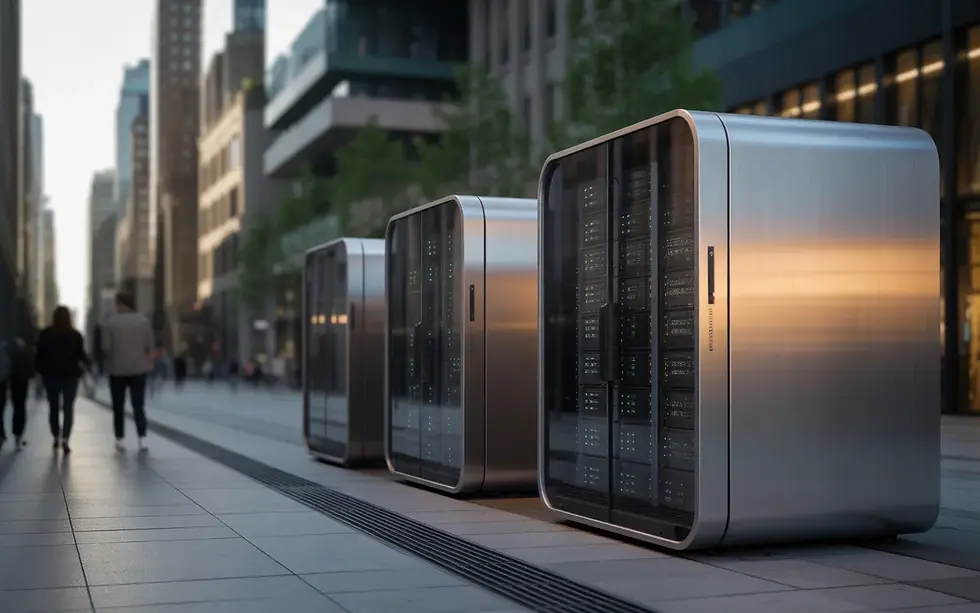
Urban nano data centers are reshaping how and where cloud resources are delivered.
As AI, IoT and 5G generate unprecedented data volumes, organisations are reaching the limits of a model based solely on distant hyperscale data centers. Latency-sensitive applications, regulatory constraints and energy pressure are all pushing compute back into cities, closer to users and devices. In this context, compact, highly efficient “urban nano data centers” – essentially micro data centers embedded in the urban fabric – are emerging as a key building block for localized cloud computing.
In this article, we explain what urban nano data centers are, why they matter, how they compare to traditional cloud and edge architectures, and how an integrator like Score Group can help design such infrastructures at the crossroads of energy performance and digital innovation.
From Hyperscale To Urban Nano: Why The Cloud Is Moving Closer
Global demand for compute is exploding. The International Energy Agency (IEA) estimates that data centers consumed about 415 TWh of electricity in 2024 – around 1.5% of global electricity use – and that this could more than double to roughly 945 TWh by 2030, approaching 3% of global demand.iea.org This growth is driven largely by AI workloads and cloud services.
At the same time, many next-generation applications – from autonomous systems to real-time analytics – cannot tolerate the latency of routing every request to a remote cloud region. Edge computing, which brings computation and storage closer to data sources or users, has therefore become a strategic trend for telecom operators, cloud providers and enterprises alike.en.wikipedia.org
The limits of centralised cloud alone
Traditional cloud and large colocation facilities remain essential, but they face several structural limitations when used alone:
Latency: Even tens of milliseconds of delay can be unacceptable for industrial automation, AR/VR, connected vehicles or critical healthcare systems.
Bandwidth costs: Backhauling massive raw data streams (video, sensor data, telemetry) to remote regions is expensive and sometimes unnecessary when only local aggregation or filtering is required.
Resilience: A purely centralised model can create single points of failure at the network or regional level, affecting local operations.
Regulation and sovereignty: Some data must remain in a specific country, city, sector or even building for legal, contractual or ethical reasons.
Energy and environmental impact: Concentrating huge loads in a few gigawatt-scale hubs raises grid and cooling challenges, triggering public concern in several regions.iea.org
To address these constraints, infrastructure is evolving into multi-layer architectures, combining central cloud, regional edge sites and very small, distributed facilities embedded directly in urban environments.
What we mean by “urban nano data center”
The industry frequently uses the term micro data center for self-contained, compact units that replicate core data center functions – power, cooling, networking and racks – in a footprint as small as a single cabinet or enclosure.en.wikipedia.org They typically support loads from a few kilowatts to tens of kilowatts and are commonly deployed for edge computing.
In this article, we use urban nano data center to describe a specific subset of such facilities:
Very small, modular data center nodes (often a few racks or less) integrated into existing urban buildings or infrastructure;
Designed from the outset for localized cloud services, with cloud-native orchestration and integration into wider hybrid or multi-cloud platforms;
Optimised for energy efficiency, heat recovery and interaction with local building systems and low-carbon energy sources;
Managed as part of a distributed mesh of edge sites rather than isolated server rooms.
They might sit in the technical floor of an office tower, in a hospital’s IT room, in a metro station, at a mobility hub, inside a telco central office, or in a dedicated micro data center pod on a rooftop.
Key Characteristics Of Urban Nano Data Centers
Ultra-local placement
Urban nano data centers are deployed where data is generated or used:
Commercial buildings (offices, shopping malls, stations, airports, stadiums);dgtlinfra.com
Industrial and logistics sites inside or near cities;
Healthcare and public-sector facilities requiring strict data locality;
Telecom sites (5G base station aggregation points, central offices);
Smart city infrastructure (traffic management centers, mobility hubs, district energy nodes).
This proximity drastically reduces round-trip latency and alleviates pressure on metropolitan backbones while enabling context-aware services tailored to each neighbourhood or facility.
Modular, standardised “data center in a box” design
Instead of custom-built computer rooms, urban nano data centers typically rely on pre-engineered modules:
Rack- or container-based enclosures with integrated power distribution, UPS, cooling and environmental monitoring;en.wikipedia.org
Support for high-density IT (including GPU servers for AI inference) in very small footprints;
Factory-tested systems that can be deployed quickly and replicated across multiple sites.
This approach reduces deployment time and simplifies maintenance, which is essential when scaling from one site to tens or hundreds across a city.
Cloud-native and edge-native software stack
Urban nano data centers are generally operated as part of a wider hybrid cloud architecture:
Workloads orchestrated with containers and Kubernetes across nano, regional and central cloud tiers;
Software-defined networking (SD-WAN, secure overlays) to interconnect sites and clouds;
Zero-trust security, remote management and observability tools to operate distributed infrastructure with minimal on-site staff;
Integration with 5G and multi-access edge computing platforms to serve mobile and IoT devices with ultra-low latency.verizon.com
Integrated energy and building management
Because these sites are embedded in the urban fabric, their design must be tightly coupled with building and energy systems:
Connection to Building Management Systems (BMS/GTB-GTC) for coordinated control of HVAC, fire safety and access control;
Optimised power usage effectiveness (PUE) and cooling strategies adapted to constrained spaces;
Possibility to reuse waste heat for nearby offices, housing or district heating networks, an approach already being deployed for larger data centers.iea.org
Integration with on-site photovoltaics, battery storage or other distributed energy resources to reduce grid impact.
This is precisely where the convergence of energy engineering and digital infrastructure becomes critical.
Benefits Of Localized Cloud In The City
Ultra-low latency and high bandwidth
Edge computing is fundamentally about reducing the physical and logical distance between users/devices and the compute resources that process their data.en.wikipedia.org In 5G environments, moving compute and storage closer to users via multi-access edge computing (MEC) enables ultra-reliable, low-latency communications for mission-critical services.verizon.com
Typical benefits of urban nano data centers include:
Response times below 10 ms for suitable applications;
Local processing of high-volume data (video analytics, industrial sensors) with only aggregated results sent to the cloud;
Smoother user experiences for AR/VR, cloud gaming, immersive retail and smart mobility services.
Data residency, compliance and sovereignty
Urban nano data centers allow sensitive data to remain within a specific jurisdiction, building or campus while still benefiting from cloud-native tools and automation. This can simplify compliance with sectoral regulations (healthcare, finance, public sector) and corporate data governance policies.
Typical patterns include:
Storing and processing personal or regulated data locally, while sending anonymised or aggregated data to central clouds;
Running security-sensitive workloads in on-premise nano nodes with controlled physical access;
Aligning IT architecture with local “data sovereignty” strategies at city or national level.
Resilience and continuity of operations
Rather than relying on a single large site, an organisation can distribute capacity across multiple nano data centers, each serving local needs but orchestrated centrally. This supports:
Improved fault isolation – local incidents do not automatically impact all sites;
Business continuity strategies (PRA/PCA) with active-active or active-standby configurations between urban nodes and regional facilities;
Graceful degradation: in case of wider network issues, critical local services can continue to operate autonomously.
Energy efficiency and sustainability
As data center energy use rises, deploying more efficient, context-aware infrastructure becomes a strategic issue. The IEA projects that global data center electricity consumption could more than double to around 945 TWh by 2030, driven mainly by AI.iea.org
Well-designed urban nano data centers can contribute positively to sustainability strategies by:
Using high-efficiency cooling in small, modular enclosures;
Reusing waste heat to reduce building or district heating demand;iea.org
Aligning IT load with on-site renewable generation and energy storage through smart control;
Reducing the need to build ever-larger hyperscale sites in constrained or water-stressed regions.
New digital services and business models
With compute and data hosted closer to citizens and assets, cities and enterprises can roll out new services more easily, for example:
Real-time traffic optimisation and smart mobility;
Dynamic energy management for buildings and microgrids;
Predictive maintenance for urban infrastructure;
Hyper-personalised in-store and venue experiences based on local analytics;
AI-driven quality control and robotics in urban manufacturing or logistics hubs.datacenters.com
How Deployment Models Compare
Central Cloud, Regional Edge And Urban Nano: A Side-By-Side View
Characteristic | Central Cloud / Hyperscale DC | Regional Edge Data Center | Urban Nano Data Center |
|---|---|---|---|
Typical location | Large, dedicated campuses often outside major cities | Metro-area or regional facilities near major hubs | Inside city buildings or micro-sites close to users/devices |
Distance to end user | Hundreds to thousands of kilometers | Tens to a few hundreds of kilometers | From the same building to a few kilometers |
Latency (indicative) | ~30–150+ ms | ~10–40 ms | Sub-10 ms possible for well-designed use cases |
Typical capacity | 10s–100s of MW | 1–20 MW | 1–100 kW (often a few racks or less)dgtlinfra.com |
Primary strengths | Massive scale, elasticity, global reach, rich services | Lower latency, regional data residency, good scale | Ultra-low latency, fine-grain localization, tight coupling with sites and buildings |
Main limitations | Higher latency, backhaul dependence, sovereignty concerns | Still not close enough for some real-time workloads | Distributed complexity, space constraints, coordination across many small sites |
Typical use cases | Bulk compute, storage, analytics, SaaS, global services | Regional content delivery, enterprise workloads, backup | Smart buildings, city services, industrial edge, local AI inference |
Concrete Use Cases For Urban Nano Data Centers
Smart and energy-efficient buildings
In large office towers, campuses or mixed-use complexes, a nano data center can host:
Building management systems (BMS/GTB-GTC) and energy optimisation algorithms;
Real-time analytics on HVAC, lighting and occupancy sensors;
Access control, video surveillance and visitor management platforms;
Digital workplace services and collaboration platforms with low latency.
When combined with on-site solar, storage and advanced control systems, this creates a virtuous loop where digital intelligence drives energy savings and sustainability outcomes.
Smart cities and urban mobility
Cities can deploy nano data centers at mobility hubs, traffic control centers or district service nodes to support:
Real-time traffic light optimisation and congestion analytics;
Connected vehicle infrastructure (V2X) and road safety systems;
Smart parking, charging and multimodal transport coordination;
Local processing for CCTV and public safety sensors, with privacy-by-design approaches.
Industry 4.0 and urban logistics
Urban manufacturing or logistics sites can benefit from local compute to power:
High-frequency sensor data collection and processing on production lines;
AI-based quality inspection using high-resolution cameras;
Automated guided vehicles (AGVs) and robotics;
Warehouse optimisation, demand forecasting and digital twins.
Healthcare and critical public services
Hospitals and public safety organisations are particularly sensitive to latency, availability and data protection. Nano data centers inside or close to such facilities can host:
Clinical systems and imaging platforms requiring large local storage;
AI-assisted diagnostics operating on sensitive data that must remain on-site;
Telemedicine services with high-quality, low-latency video;
Emergency response platforms that must stay operational even if external connectivity is degraded.
Retail, media and immersive experiences
Shopping centres, stadiums and entertainment districts are ideal locations for urban nano data centers delivering:
In-venue AR/VR and immersive experiences with ultra-low latency;
Dynamic digital signage driven by real-time analytics;
Local content caching and streaming to handle peak audiences;
Context-aware loyalty and customer engagement platforms.
Challenges And Design Considerations
Site selection and urban constraints
Embedding data center-grade infrastructure into existing buildings or dense urban areas raises specific constraints:
Space: finding suitable technical rooms or micro-sites with adequate floor loading;
Cooling: designing efficient solutions that respect noise, vibration and aesthetic requirements;
Power: ensuring enough capacity and redundancy in buildings that were not always designed for high-density IT;
Permits and neighbours: managing safety, fire protection, access and regulatory compliance.
Network and architecture design
Urban nano data centers must be integrated into a coherent network and application architecture:
Secure, redundant connectivity between nano sites, regional edges and central clouds;
Traffic engineering to keep latency-sensitive workloads local while offloading heavy compute to regional or central sites when possible;
Clear workload placement policies (what runs where, under which conditions);
Alignment with 5G, Wi‑Fi and wired LAN/WAN strategies.
Security by design
Because nano data centers may be placed in more exposed locations than traditional facilities, security must be multi-layered:
Physical protection (access control, surveillance, tamper detection);
Network and endpoint security, including micro-segmentation and zero-trust principles;
Robust identity, logging and monitoring across all sites;
Regular audits, penetration tests and incident response processes.
Operations, monitoring and automation
Managing dozens of small sites is very different from operating a single large data center. Success requires:
Unified monitoring for IT, facilities and energy systems;
Automation for deployment, configuration and updates (infrastructure as code);
Remote management capabilities to minimise on-site interventions;
Standard operating procedures and training for both IT and facility teams.
How Score Group Approaches Urban Nano Data Centers
Score Group positions itself as a global integrator at the intersection of energy, digital infrastructure and new technologies. Our tripartite approach – Energy, Digital, New Tech – is particularly well suited to projects involving urban nano data centers and localized cloud architectures.
Each division brings complementary expertise:
Noor Energy focuses on intelligent, sustainable energy performance: energy monitoring and optimisation, smart building management (GTB/GTC), renewable integration (solar PV, storage) and sustainable mobility. This is essential to design nano data centers that are not only reliable but also efficient and compatible with local energy ecosystems.
Noor ITS provides the digital backbone: IT infrastructure (networks, systems), data center design and optimisation, cloud and hosting strategies, cybersecurity, digital workplace and business continuity (PRA/PCA). These capabilities underpin the technical architecture and resilience of urban nano data center deployments.
Noor Technology brings new technologies into play: artificial intelligence, RPA, IoT and smart connectivity, and custom application development. These solutions leverage localized compute to create concrete business value on top of nano data center infrastructure.
By combining these three pillars, Score Group can support organisations that wish to:
Assess the relevance of localized cloud and edge architectures for their operations;
Define a roadmap for deploying urban nano data centers in one or multiple sites;
Integrate these nodes with existing clouds, networks and building systems;
Align IT, energy and innovation strategies around measurable performance and sustainability objectives.
FAQ: Urban Nano Data Centers And Localized Cloud
What is an urban nano data center in practical terms?
An urban nano data center is a very small, highly integrated data center node deployed inside the city, typically within an existing building or micro-site. It includes racks, power, cooling, networking and monitoring in a compact enclosure, often just a few square meters. Functionally, it behaves like a “mini cloud region” dedicated to local workloads: smart building systems, industrial edge applications, city services or low-latency digital experiences. It is managed remotely and orchestrated alongside regional and central cloud resources as part of a unified hybrid architecture.
How is a nano data center different from a traditional edge or micro data center?
A nano data center is conceptually close to a micro data center, but with two specific emphases: location and integration. First, it is deliberately embedded in dense urban environments, as close as possible to users and assets, rather than simply “near the network edge.” Second, it is designed from day one to integrate with building systems, local energy resources and wider cloud platforms. In other words, every nano node is part of a larger, orchestrated mesh of edge sites, not just an isolated server room or branch office IT rack.
Are urban nano data centers more energy-efficient than large data centers?
Energy efficiency depends heavily on design and operation. Hyperscale data centers can achieve very low PUE thanks to advanced cooling and economies of scale.en.wikipedia.org Nano data centers, by contrast, operate at smaller scale but can exploit their urban context: using high-efficiency, right-sized cooling; tightly coordinating with building management systems; and reusing waste heat locally.iea.org When engineered properly and integrated with renewables or district heating, they can contribute meaningfully to local decarbonisation strategies, even if their absolute scale is smaller than hyperscale campuses.
Which use cases benefit most from urban nano data centers?
The strongest candidates combine low-latency requirements, high data volumes and local context. Examples include smart building control and energy optimisation, industrial automation in urban factories, traffic management and smart mobility, AI-powered video analytics, and immersive experiences in retail or venues. In these scenarios, processing data locally reduces backhaul traffic, improves responsiveness and can help keep sensitive information on-site. For more batch-oriented or globally distributed workloads, central cloud or regional data centers often remain the best fit, complemented by nano nodes where needed.
How can an organisation start exploring nano data center projects with Score Group?
For most organisations, the first step is not hardware, but strategy. Together, we would clarify your business objectives (latency, sovereignty, resilience, sustainability), map existing sites and networks, and identify high-impact use cases. From there, Score Group and its divisions – Noor Energy, Noor ITS and Noor Technology – can help design reference architectures, pilot an initial nano site in a flagship building or campus, and define how to scale across your portfolio. To begin the conversation, you can reach out to Score Group via our website and outline your priorities around energy performance and digital transformation.
What’s Next?
Urban nano data centers are not a replacement for the cloud, but a powerful extension of it – bringing cloud capabilities into the heart of cities, buildings and critical infrastructures. If you are considering low-latency services, smarter energy management or more resilient local IT, now is the right time to evaluate how localized cloud architectures could support your strategy.
At Score Group, our mission is to align energy performance, digital infrastructure and new technologies into tailored solutions for each organisation. To explore how this approach could apply to your sites and projects, visit score-grp.com and get in touch with our teams.